Extreme temperatures punish batteries. Standard NiMH loses capacity in the cold and ages fast in heat. Wide-temperature (WT) NiMH uses specialized electrolyte and separator engineering to operate reliably from -20°C to +60°C, making it the chemistry
Intro
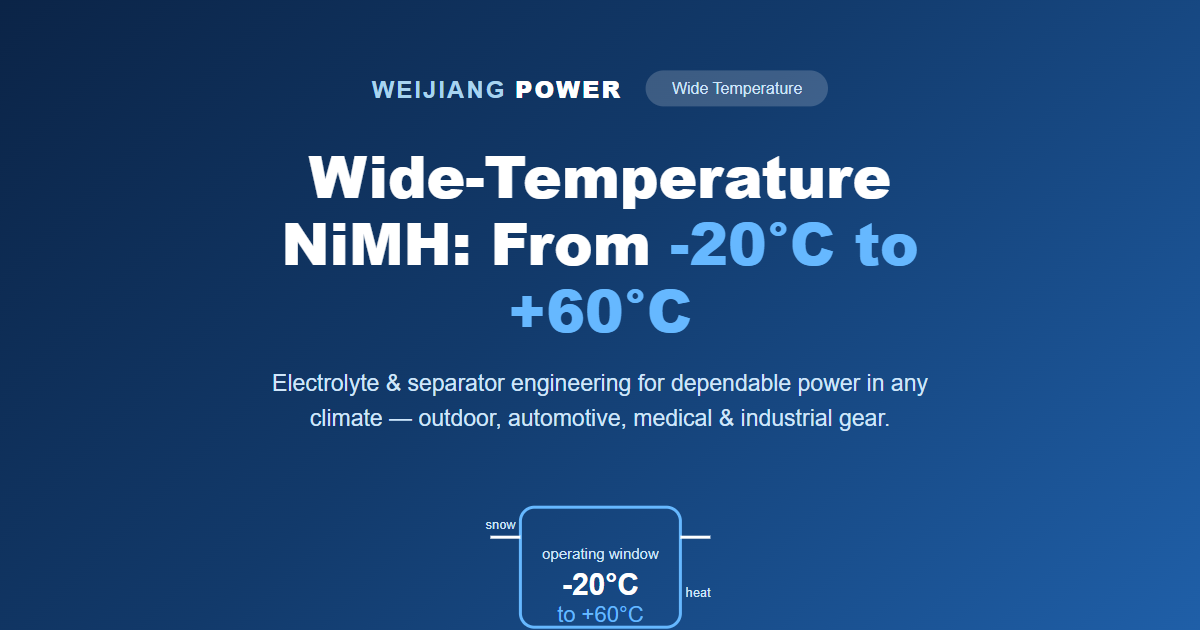
Extreme temperatures punish batteries. Standard NiMH loses capacity in the cold and ages fast in heat. Wide-temperature (WT) NiMH uses specialized electrolyte and separator engineering to operate reliably from -20°C to +60°C, making it the chemistry of choice for outdoor, automotive, medical-transport and industrial equipment that must work in any climate.
Body
1. How temperature affects NiMH
- Cold (-20°C): electrolyte viscosity rises, ionic conductivity drops → capacity and voltage sag increase; charge acceptance plummets if charged cold.
- Heat (+60°C): accelerates separator degradation, self-discharge, and oxygen recombination reactions → reduced cycle life.
WT cells are formulated to flatten both extremes.
2. WT electrolyte & separator engineering
- Modified KOH–LiOH–NaOH electrolyte lowers freezing point and maintains conductivity at -20°C.
- Higher-thermal-stability separator resists degradation at +60°C.
- Additive packages suppress gas recombination and micro-shorts across the temperature band.
- Electrode coatings tuned for reduced charge-transfer resistance at low temperature.
3. Measured WT performance
- Discharge at -20°C: retains ~70–80% of room-temperature capacity at moderate rates (vs ~40–50% for standard).
- Sustained operation at +60°C with reduced capacity fade.
- Operating range: -20°C to +60°C (charge recommended >0°C unless designed otherwise).
- Cycle life: 500–1000+ cycles across the range.
4. Applications
- Outdoor & field equipment: GPS trackers, radios, weather stations, solar-storage buffers.
- Automotive / EV accessory: remote key fobs, tire-pressure sensors, dash-cam backup.
- Medical transport: infusion pumps, patient monitors used in ambulances.
- Industrial: emergency lighting, security cameras, oilfield/utilities remote gear.
5. Cold-charge caution
Even WT cells should be charged above 0°C to avoid lithium-free dendrite risk and reduced charge acceptance. Design system charge cutoffs (ΔV/ΔT) accordingly. For -20°C charging, specify a dedicated cold-charge-optimized variant.
Conclusion
Wide-temperature NiMH removes the "too hot / too cold" failure mode that plagues general-purpose rechargeables. For equipment that must run anywhere, WT NiMH delivers dependable power across -20°C to +60°C with the intrinsic safety NiMH is known for. Weijiang offers WT variants in AA, AAA, SC, C, D and custom pack formats.


